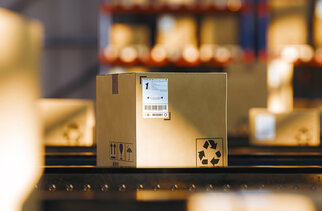
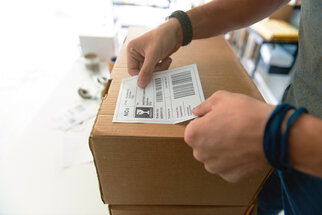
With the European Packaging Waste Regulation (PPWR) coming into force in August, HERMA’s Labels division is expanding its range with the new Linerless Plus, offering a linerless – and therefore resource-efficient – labelling solution for logistics, dispatch or other industrial applications. Alongside the silicone-free HERMA InNo-Liner for automated print-and-apply applications, a classic linerless solution is now available that is suitable both for automated labelling and for label printing using desktop printers followed by manual application – a method that remains widely used in logistics centres. At the same time, with Linerless Plus, HERMA has specifically addressed the known weaknesses of conventional linerless solutions: users now benefit from particularly good adhesive properties and improved cutting performance, as well as reduced build-up in the printer. “There is no single linerless solution that suits every application,” says Sven Pleier, Key Account Manager in the Labels division at HERMA. “The labelling process, the technology used and the requirements placed on the label are all crucial factors. But for almost all labelling applications in logistics and dispatch, we can now offer linerless labelling with InNo-Liner and Linerless Plus.” Linerless labels do not require the backing material used in conventional self-adhesive labels. This reduces material consumption and avoids waste that has to be disposed of after labelling. For example, for every 1.5 million labels in the standard format of 105 x 148.5 millimetres, it is possible to save around 1.37 tonnes of backing material whilst maintaining the same labelling output, and to reduce CO₂ emissions by 1.42 tonnes.
Classic linerless, with known weaknesses reduced
With Linerless Plus, HERMA builds on the established principle of self-adhesive linerless labels, which feature a silicone release layer on the top side of the label. It can be used in all standard printers and print-and-apply systems designed for self-adhesive linerless labels. During development, HERMA succeeded in resolving a well-known trade-off associated with traditional linerless solutions: high adhesive strength requires a sufficient amount of adhesive; at the same time, however, this adhesive can contaminate the print-and-apply system when the labels are cut, thereby necessitating cleaning and maintenance. The multi-layer adhesive used in Linerless Plus, which was developed in-house, enables adhesive to be applied across the entire surface – in contrast to standard solutions on the market, which usually require adhesive-free zones for cutting. These adhesive-free zones not only reduce the adhesive strength but also increase the risk of labels lifting up later and sticking to one another, which can lead to disruptions in the logistics process.
Linerless Plus, on the other hand, combines very high initial and final adhesion across the entire surface with good processing properties when cutting the labels in the printer – the cutting mechanisms become less contaminated, thereby reducing the effort required for cleaning and replacing components. This reduces downtime and improves process reliability. At the same time, the high adhesive strength enables the product to be used on more challenging surfaces. These include, for example, shipping labels on rough cardboard surfaces or plastic wrap around pallets.
As Linerless Plus has no adhesive-free zones, users also have greater flexibility when it comes to label dimensions. “It is now easier to order roll widths that differ from the usual standard dimensions,” explains Pleier. “This, too, can lead to both environmental and economic benefits.”
Two approaches to linerless labels
With Linerless Plus, HERMA is expanding its range of existing silicone-free HERMA InNo-Liner labels, in which the adhesive layer is activated by water only immediately before the label is applied. Linerless Plus, on the other hand, follows the classic siliconised linerless principle. This makes it suitable for both compatible print-and-apply systems and desktop printers, whilst also opening up applications on other surfaces, such as films.
Together with cab, HERMA offers system solutions for both concepts: a print-and-apply system for HERMA InNo-Liner and Linerless Plus, as well as desktop printers for Linerless Plus labels. Linerless Plus labels can also be used in suitable linerless devices from other manufacturers. “For many companies, the question of how they can reduce material use and waste in labelling without compromising on process reliability and productivity is becoming increasingly important,” emphasises Sven Pleier. “With our expanded range of linerless solutions, we can now provide a suitable answer for almost all logistics and dispatch applications; this even opens up new options for product labelling.”